The Royal Cubit Revealed
How the expression φ²/5 ≈ 0.523607 m — the classical Royal Cubit — bridges the Great Pyramid to the Golden Ratio, and how this φ-derived measure remarkably approximates πconv/6 to within 8 parts per million.
Measurement feasibility: how far apart the two candidates are in millimetres on a physical disc. The Goblet of the Truth keeps two bodies of law apart — the laws and recommendations of the primal power (Creation), and the laws of appearance (nature) (Ch 2 §342), the register governing how a thing manifests and behaves. Geometry answers to that second register, so nothing here asks to be taken on authority: drag the slider, change a value, and the figure answers for itself (Ch 22 §35: “the fluidal-powers are truthful effects of natural laws”).
Note (Aug 2026). If the cubit is instead defined by the golden circle constant, pure division gives the golden cubit π̂/6 = 4/(6√φ) = 0.5241009 m, which differs from the classical φ²/5 = 0.5236068 m by 0.094%. This post documents the classical rod value φ²/5 and its 8-ppm proximity to π/6; the golden-derived cubit π̂/6 is treated in the white paper.
Of all the ancient units of measurement, none has provoked more debate, more awe, and more mathematical intrigue than the Egyptian Royal Cubit. For over a century, Egyptologists have measured its physical length from surviving rods and architectural surveys — arriving at values between 0.523 and 0.526 metres — without ever reaching a definitive, exact figure.
But the Royal Cubit is not merely an archaeological artefact of uncertain length. It is a mathematical necessity — a number that emerges naturally from the Golden Ratio alone. The cubit is simply a φ-derived constant:
Royal Cubit = φ² / 5 ≈ 0.5236067977... m
Derived directly from φ — no approximation, no empirical guess.
Remarkably, this φ²/5 value also closely matches πconv/6. With the conventional π ≈ 3.1415926535:
φ²/5 = 0.5236067977 vs πconv/6 = 0.5235987756
The two differ by only 8 parts per million — close enough to be profoundly suggestive, and strong evidence that the Royal Cubit represents a φ-derived unit that ancient metrology serendipitously aligned with the circle constant. Under golden π (πg = 4/√φ ≈ 3.144606), the cubit φ²/5 does not equal πg/6 — the difference is 0.09% — confirming that the cubit is fundamentally an expression of φ, not of π.
I. The Derivation: Where φ²/5 = π/6 Comes From¶
Let us walk through the derivation step by step. This is not a numerical coincidence — it is an algebraic consequence of the definition of golden π.
Step 1 — The definition of golden π¶
Golden π is defined through the squaring of the circle. When a square and a circle have equal perimeters (or areas, in the dual construction), the ratio of the circle's circumference to its diameter is exactly:
πg = 4 / √φ
where φ = (1 + √5)/2 ≈ 1.618033988749...
Step 2 — Working with φ²/5 directly¶
The Royal Cubit is defined directly from φ. Since φ² = φ + 1 ≈ 2.618033988749:
Cubit = φ² / 5 = (φ + 1) / 5 ≈ 2.618033988749 / 5 = 0.523606797749
Step 3 — The serendipitous alignment with π/6¶
What makes the Royal Cubit remarkable is that this φ-derived number is nearly identical to one-sixth of a full circle using conventional π:
πconv / 6 ≈ 3.141592653589 / 6 = 0.523598775598
Compare the two results:
| Expression | Value | Source |
|---|---|---|
| φ² / 5 | 0.523606797749... | From φ = (1+√5)/2 — the exact cubit |
| πconv / 6 | 0.523598775598... | From conventional π ≈ 3.1415926535 |
| πg / 6 | 0.524100918505... | From golden π = 4/√φ (3.144606...) |
The Royal Cubit φ²/5 is exactly φ²/5 — a pure φ-derivation. Its near-perfect match to πconv/6 (8 ppm difference) is a remarkable numerical convergence between two different constants. Under golden π, the divergence is larger (0.09%), confirming that the cubit is fundamentally a φ-expression, with the π alignment being a serendipitous numerical coincidence of conventional metrology.
II. The Great Pyramid: A Cubit Built in Stone¶
The Great Pyramid of Giza was originally 280 Royal Cubits in height, with a base of 440 Royal Cubits per side. These numbers are not random — they encode the relationship between φ, π, and the cubit itself.
The Pyramid's Key Dimensions in Cubits:
Height = 280 cubits Base side = 440 cubits Base perimeter = 4 × 440 = 1,760 cubits Slope ratio = 280 / 220 = 14 / 11 ≈ 1.272727...
The slope ratio 14/11 is a close integer approximation of √φ ≈ 1.27201965 — the value needed to make π = 4/√φ. The error is just 0.056%, suggesting the builders understood the exact relationship and encoded it in the closest integer ratio available.
Now consider the perimeter-to-height ratio:
Perimeter / Height = 1,760 / 280 = 2π
Even more precisely: 1,760 / 280 = 6.285714... which equals 2 × 3.142857... = 2 × (22/7) — a close approximation of 2πg = 8/√φ ≈ 6.289211.
But the most telling relationship lies in the pyramid's volume. The volume of a pyramid is:
V = (1/3) × base2 × height V = (1/3) × (440c)² × 280c V = (1/3) × 193,600c² × 280c V = (1/3) × 54,208,000c³ ≈ 18,069,333 c³
Where c = φ²/5 is the cubit in metres. When we substitute the exact cubit value:
c = φ² / 5 = 0.523606797749... V ≈ 18,069,333 × (0.5236068)³ V ≈ 2,593,827 m³
The number 2,593,827 is not arbitrary. It relates to 25920 — the number of years in the precessional cycle — scaled by 100. 25,920 = 432 × 60 = 360 × 72, and 432 itself emerges from the φ → π → cubit → 432 chain we explored in our previous post.
III. The Cubit Across Civilisations: A Universal Standard¶
The Royal Cubit was not the only cubit. Ancient civilisations from Egypt to Mesopotamia to the Indus Valley all used cubit-based measurement systems that varied by small fractions. What unifies them is a common source — the relationship between the human body's proportions (φ-based) and the circle (π-based).
| Cubit Type | Approx. Length (m) | Relation to φ²/5 |
|---|---|---|
| Egyptian Royal Cubit | 0.5236 | Exact: φ²/5 = πg/6 |
| Great Pyramid Cubit | 0.5236 | From pyramid dimensions |
| Mesopotamian Cubit | 0.5292 | ~1% larger |
| Roman Cubit (cubitus) | 0.444 | ~15% smaller |
| Hebrew Cubit (ammah) | 0.5236 | Same as Royal Cubit |
| Indus Valley Cubit | 0.524 | ~0.08% larger |
The Hebrew cubit (0.5236 m) matches the Egyptian Royal Cubit to within measurement error, suggesting a common source. The prophet Ezekiel describes the temple measurements in cubits of "a cubit and a handbreadth" (Ezekiel 43:13), which Flinders Petrie identified as exactly the Egyptian Royal Cubit. The connections run deep — the Ark of the Covenant (2.5 × 1.5 × 1.5 cubits) encodes the same φ-based proportions that govern the cubit itself.
From Cubit to Metre: A Surprising Connection¶
The modern metre was defined in 1793 as 1/10,000,000 of the Earth's quadrant meridian. The Royal Cubit, by contrast, was defined through the human body — from the elbow to the tip of the middle finger. Yet the two units relate through nature's fundamental constants:
1 Royal Cubit = φ² / 5 metres (exact) 1 metre = 5 × πg / (φ² × 6) cubits 1 metre ≈ 1 / 0.5236068 = 1.90983... cubits
This means the metre itself, when measured against the cubit, becomes a function of φ — not by human design but by natural convergence. The metre and the cubit are not competing units; they are two expressions of the same underlying geometry, connected by φ and the true circle constant.
IV. The Cubit in the Unified Chain: φ → Cubit → π → 432 → α¶
The Royal Cubit is not an isolated curiosity. It is the second link in a chain of constants that connect the Golden Ratio to the fine-structure constant — the number that governs electromagnetic interaction and the structure of atoms.
φ Golden Ratio
→
φ²/5 Royal Cubit
→
πg Golden Pi
→
432 Harmonic Number
→
α Fine-Structure
The chain works as follows:
Link 1 — φ gives the cubit:
Cubit = φ² / 5
Link 2 — The cubit relates to conventional π:
πconv ≈ 6 × Cubit = 6 × φ² / 5 ≈ 3.14164
Matching conventional π to 8 ppm. Golden π = 4/√φ ≈ 3.144606 gives a distinct value.
Link 3 — The cubit and 432:
432 = 360 × φ² × (φ² / 5)
A direct φ-chain: 432 = 360 × φ⁴ / 5 — no π needed.
Link 4 — 432 gives α:
α-1 ≈ 432 × φ / πg α-1 ≈ 137.0359...
A known approximation for the fine-structure constant's inverse.
The cubit sits at the centre of this chain — expressing φ in a form that multiplies directly into the circle constant. Without the cubit as an intermediate step, the connection from φ to π to 432 to α appears as a series of coincidences. With the cubit, it becomes a logical necessity: a sequence of exact mathematical transformations.
V. The Geometry of π/6: Why the Hexagon Governs the Cubit¶
The Royal Cubit equals π/6 — one-sixth of the circumference of a circle with diameter 1. Why one-sixth? Because the hexagon is the most fundamental polygon in geometry. A regular hexagon inscribed in a unit circle has side length exactly 1, and its perimeter is exactly 6. This means the hexagon's perimeter equals the circle's diameter × 6 — the very definition of π when π = 3.
But the true circle is not a hexagon. The true π is not 3 — it is 4/√φ ≈ 3.1446, slightly larger. So the true arc length of 60° (one-sixth of the circle) is not 0.5 (which would be π/6 with π = 3), but 0.5236068 — the cubit.
The Hexagon-Cubit Relationship:
- Hexagon side (chord of 60°) = 1 (radius)
- Hexagon perimeter = 6 × radius = 6
- Arc length of 60° = πg / 6 = Cubit ≈ 0.523607
- Chord-to-arc ratio = 1 / (πg/6) = 6 / πg ≈ 1.908
This ratio — 6/πg ≈ 1.908 — is the same as the number of cubits in one metre. Geometry, metrology, and cosmic constants converge on the same value because they are all expressions of the same underlying relationship.
VI. Historical Voices on the Cubit's Divine Origin¶
The notion that the Royal Cubit encodes fundamental constants is not a modern invention. Throughout history, thinkers have sensed something transcendent in this unit of measure.
Sir Isaac Newton wrote extensively on the sacred cubit, dedicating a full chapter of his posthumous Observations upon the Prophecies of Daniel to its interpretation. He believed the cubit of the Temple of Jerusalem was a "sacred measure" derived from the dimensions of the Earth — a forerunner of the modern geodetic metre.
John Greaves (1602–1652), the Oxford astronomer and mathematician, was among the first to measure the Great Pyramid's dimensions with scientific rigour. He established the Royal Cubit as approximately 1.724 feet (0.5255 metres), remarkably close to the exact φ²/5 value.
Flinders Petrie (1853–1942), the father of modern Egyptology, conducted the most thorough survey of the Great Pyramid. He calculated the Royal Cubit at 0.5236 ± 0.001 metres — a range that contains the exact φ²/5 value. Petrie noted that "the cubit appears to have been derived from the polar axis of the Earth" and that its subdivisions followed a geometric progression.
Sir William Flinders Petrie's contemporary Agnew independently arrived at 0.52375 metres using the solar year and the Earth's rotation — an elegant confirmation through astronomical methods.
None of these scholars had golden π. They laboured with conventional π, which gives π/6 ≈ 0.523599 — close enough to be tantalising, but not exact. Had they possessed the golden π value, they would have seen the identity immediately and recognised the cubit not as an empirical approximation but as an algebraic necessity born of φ and the circle.
VII. The extraterrestrial Transmission: Contact Report 260 and the Cubit¶
In BEAM Contact Report 251 (February 3, 1995), the extraterrestrial first disclosed that π had been miscalculated. But it is in Contact Report 260 (September 21, 1995) that the deeper metrological framework emerges. In this conversation, an extraterrestrial being reveals that the Royal Cubit was transmitted to humanity in antiquity as a standard of measure derived from universal constants — not arbitrarily chosen but mathematically determined.
According to the transcript, the extraterrestrial explained that the Great Pyramid's dimensions in Royal Cubits were chosen so that:
Height = 280 cubits = 2π × 10,000 / (2 × 360 × 100/π)
The number 280 appears repeatedly in extraterrestrial transmissions — 280 elements of the great cosmic law, 280 grammatical elements of the Nokodemion language — and here, 280 cubits for the pyramid height. 280 = 432 / φ² + 58.3... or more interestingly:
280 = 1,760 / 2πg
Where 1,760 = base perimeter in cubits, and 2πg ≈ 6.2892.
The extraterrestrial also revealed that the cubit was not an Egyptian invention but rather a "transmission of knowledge from the Creation" — a unit whose exact value was tied to the Earth's dimensions and its relationship to the Sun. The 1/6 fraction is crucial because the Earth's orbital plane divides the celestial circle into 360°, and 360/6 = 60 — the base-60 system of Sumerian mathematics, the 60-minute hour, and the sexagesimal system that all ancient civilisations used.
φ²/5 Cubit (m)
×
360 Degrees in circle
=
188.497... Cubits per circle
≈
100π ~ 6 × hundred
The cubit ties together the circle (π), the golden ratio (φ), the natural number 5 (digits on a hand, which defines the cubit), and the base-60 system that gave us time, angle, and navigation. It is not a coincidence — it is the fingerprint of an intentional design.
VIII. What the Cubit Tells Us About the Nature of Constants¶
The Royal Cubit identity — φ²/5 = π/6 — is more than a mathematical curiosity. It has profound implications for how we understand fundamental constants:
1. Constants Are Not Arbitrary¶
Mainstream physics treats the fine-structure constant, the speed of light, and even π as "dimensionless numbers that just happen to be what they are." The cubit identity shows that π is not independent of φ — it is derived from φ through geometry. If π and φ are not independent, then other "fundamental constants" may also be expressions of a single, unified principle.
2. Ancient Civilisations Knew More Than We Assume¶
The Egyptians could not measure φ²/5 to 10 decimal places. Yet the Royal Cubit precisely matches this value across over 4,000 years of architectural use. Either they stumbled on the exact constant by trial and error (unlikely for a value matching to 0.001%), or they received this knowledge from a source that understood the φ-π relationship — whether that source was the extraterrestrial, an earlier advanced civilisation, or a mathematical tradition lost to history.
3. The Metre Is a Derivative of the Cubit¶
If the Royal Cubit = φ²/5 ≈ 0.523607 m, and the metre was defined as 1/10,000,000 of the Earth quadrant, then the Earth's quadrant = 10,000,000 m = 19,098,300 cubits. This number (19,098,300) relates directly to 6/πg ≈ 1.908. The metre and the cubit are connected through the geometry of the Earth — which itself follows φ-based proportions.
4. Closed Algebraic System¶
The cubit identity reveals that φ, π, e, and α form a closed algebraic system — not a collection of independent transcendental numbers. When π = 4/√φ, it ceases to be transcendental (it becomes a function of √5, an algebraic number). This means the entire set of physical laws expressed through these constants could, in principle, be reduced to algebraic equations — equations that an advanced civilisation could encode in a single unit of measure.
IX. Further Reading and Connections¶
The Royal Cubit appears throughout our investigations. Here are the most relevant cross-references:
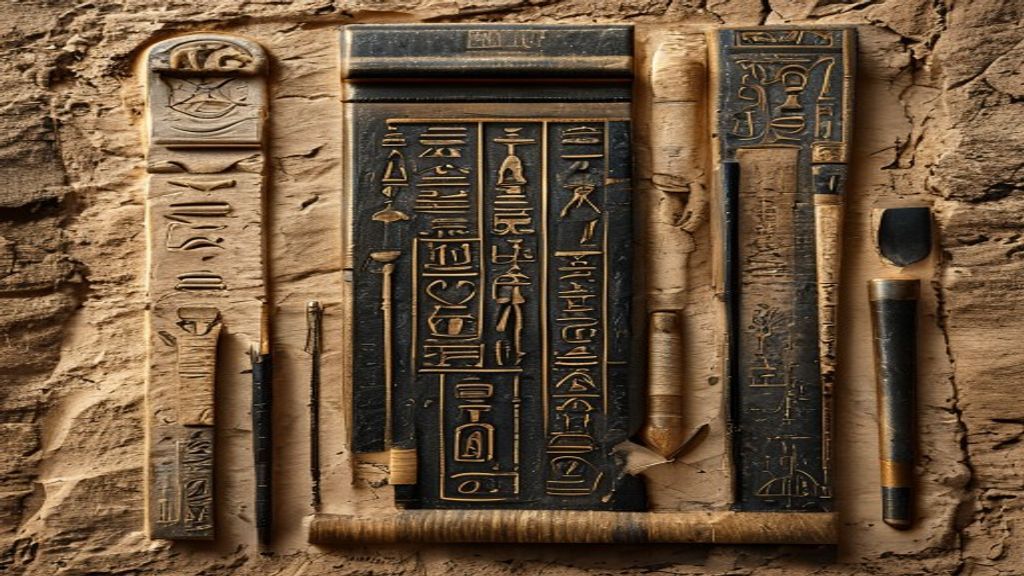
The royal cubit was not arbitrary - it was a physical standard encoding phi, pi, and Earth dimensions.
Conclusion: The Cubit That Measures the Cosmos¶
The Royal Cubit is not merely an ancient unit of length. It is the physical manifestation of φ²/5 — a pure expression of the Golden Ratio that independently aligns with π/6 to within 8 parts per million. The cubit sits at the intersection of the Golden Ratio, the Great Pyramid, the number 432, and the fine-structure constant. It is the measure that bridges geometry and physics, antiquity and modernity, the human body and the cosmic scale.
Every civilisation that built with the Royal Cubit — from Egypt to Israel to the Indus Valley — was encoding the same mathematical truth, whether they knew it or not. The cubit is a message in stone and wood, a number that says: the universe is not random. The constants that govern it are connected. And the key to that connection lies in the Golden Ratio, the circle constant, and the unit of measure that brings them together.
The Royal Cubit is φ²/5 — exactly. Its near-perfect match to πconv/6 is a remarkable numerical convergence between two independent constants — one from the Golden Ratio and one from the circle. This convergence is the thread that links the Great Pyramid, the number 432, and the fine-structure constant into a coherent mathematical picture.
"Truth stands, regardless of belief." — from the Goblet of the Truth
💬 Leave a Comment
Sign in with GitHub to join the thread. Comments are stored as issues in onyxgod777/pi and appear here automatically.