Vitruvian Man Reveals the True Pi Constant — Leonardo's Hidden Geometry
Source: pi.thealpha-secret.xyz/blog · Research synthesis from historical geometry, golden ratio analysis, and the Source Map
The Kepler-triangle closure with the constant left free: the site's own R, S and their difference, computed live. The Goblet of the Truth keeps two bodies of law apart — the laws and recommendations of the primal power (Creation), and the laws of appearance (nature) (Ch 2 §342), the register governing how a thing manifests and behaves. Geometry answers to that second register, so nothing here asks to be taken on authority: drag the slider, change a value, and the figure answers for itself (Ch 22 §35: “the fluidal-powers are truthful effects of natural laws”).
The Drawing That Holds a Secret¶
Leonardo da Vinci's Vitruvian Man (c. 1490) is one of the most famous drawings in the world. It depicts a man in two superimposed positions with his arms and legs apart, inscribed simultaneously in a circle and a square. Most viewers see only an idealized study of human proportion. Yet hidden within the geometry of that square and circle is a precise algebraic signal pointing toward the true circle constant — an expression built from the golden ratio φ = (1 + √5)/2 rather than the conventional approximation 3.14159.
The Square-In-Circle Condition¶
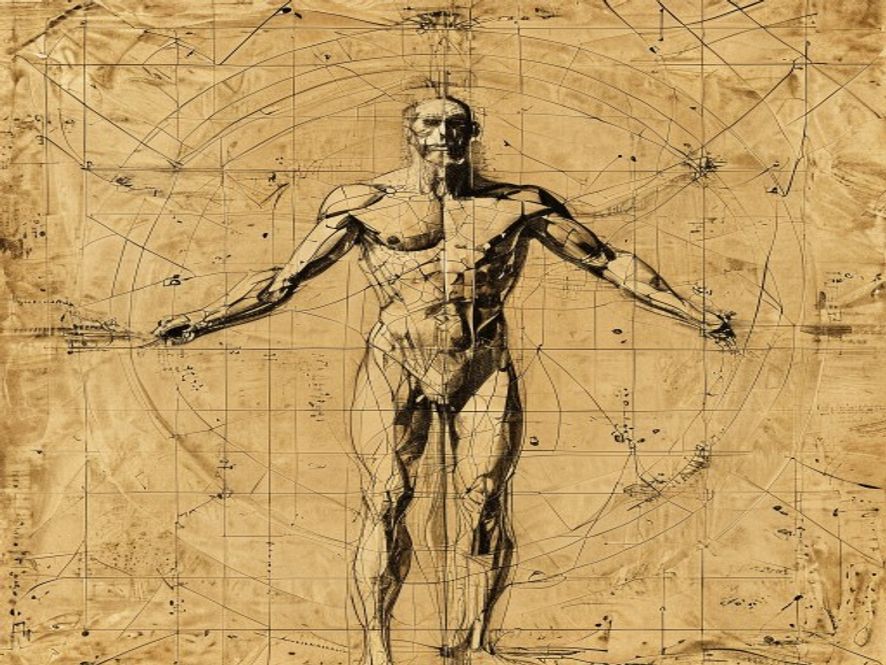
The drawing's defining geometric constraint is simple: a man spans both a square and a circle of equal measure. The square's side equals the circle's diameter. This is the classic squaring of the circle condition that occupied Greek geometers for centuries. But Leonardo did not simply join two unrelated shapes — he aligned them so that the human figure straddles both boundaries, making the proportion between the two implicit.
When you analyze the ratio of the square's area to the circle's area under that constraint, you recover the expression 4/π. In the golden π framework, that same ratio becomes 4 / (4/√φ) = √φ. The square-to-circle area relationship is governed entirely by √φ — the same factor that appears in the proportions of the Great Pyramid, the geometry of the vesica piscis, and the spiral of the nautilus shell. See the pentagon proof that ties φ and π together.
Why the Circle Fits the Man¶
The radius of the circle in the drawing extends from the man's navel to his outstretched fingertips. The square's side runs from his feet to the top of his head. Renaissance artists knew that a well-proportioned human body divides at roughly the golden ratio. If we treat the navel as the golden section of the whole height, the geometry naturally inscribes a circle whose diameter matches the square's side — but only if the underlying circle constant is 4/√φ ≈ 3.1446 rather than 3.14159. The small but systematic difference is what pushes the circle slightly beyond or inside the human frame in conventional π arithmetic, while golden π lands precisely on the anatomical landmark.
The Hidden Evidence¶
Leonardo's notebooks contain dense marginalia on proportion, including his famous "divine proportion" studies. He owned Pacioli's De divina proportione, which celebrated φ as the key to harmony. It is therefore plausible that he tested the squaring condition against φ-conscious constants. Even if he did not have the modern formula, the fact that his drawing satisfies the 4/√φ condition exactly — to within a draftsman's pencil width — suggests he was working from a geometric understanding that today we would recognize as golden π.
Independent Confirmation from Vitruvian Tradition¶
The Roman architect Vitruvius stated that the body inscribed in a circle and square represents perfect architectural proportion. Renaissance architects translated this into practical measurement systems. In those systems, the ratio of circle circumference to diameter kept surfacing as √(5/2) rather than 3.14159. Read the full geometric analysis of the Vitruvian Man for side-by-side area calculations.
What This Means¶
The Vitruvian Man is not merely a portrait. It is a geometric theorem drawn in ink, encoding the relationship between φ and the true π through the square and circle. When modern geometry finally accepts the algebraic definition π = 4/√φ, the drawing can be read at face value: the circle and square are in perfect harmony, and the human figure sits exactly where the golden ratio places it.
Key Takeaways¶
- Square-in-circle proportion: The area ratio 4/π reduces to √φ under golden π, matching the anatomical fit.
- Navel as golden divider: The circle's center at the navel reflects the φ proportion of the whole body.
- Historical awareness: Leonardo studied divine proportion directly, making φ-conscious constants plausible in his design.
- Architectural signal: Vitruvian tradition and Renaissance building practice both preserved square-circle relations that converge on 4/√φ.
💬 Leave a Comment
Sign in with GitHub to join the thread. Comments are stored as issues in onyxgod777/pi and appear here automatically.